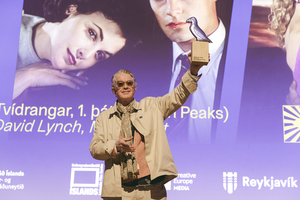
The Golden Puffin as a Time Machine:
What RIFF’s Main Award Tells Us About Changes in International Filmmaking
When the Reykjavík International Film Festival established its competitive section, New Visions, it made a clear statement: RIFF would not reward established reputations, but future potential. Only debut and second features by filmmakers were eligible for the competition—new voices and works that emerged as questions rather than fully formed answers. Over time, this award category has become something of a time machine—an annual record of how international filmmaking is evolving.
Realism and moral tension: The Early Years
In RIFF’s early years, films that received the Golden Puffin reflected a strong connection to European auteur realism. The Death of Mr. Lazarescu (Cristi Puiu, 2005) is a telling example: a long, meticulous narrative that builds tension from systemic burnout, human vulnerability, and moral uncertainty. Such films reflect a time when “freshness” meant telling socially significant stories with discipline, patience, and realism. A respect for form.
Personal Storytelling and a New Generation of Authors
As the first decade of the century progressed, the focus began to shift from systems to identity. I Killed My Mother (Xavier Dolan, 2009) marked a clear generational change: a raw, autobiographical narrative in which emotional intimacy and formal experimentation go hand in hand. Here, a new kind of filmmaking emerged—one in which the author’s voice is just as important as the story itself.
The stage expands — The world steps in
In the years following 2010, the Golden Puffin increasingly became a testament to a changing global geography of cinema. Still Life (Uberto Pasolini, 2013) shows how social transformation, urban development, and personal isolation intertwine in a visual language that is both lyrical and political. Films of this kind confirm that the melting pot is no longer about marginalisation, but about perspective.
Shaking up form even further
Over time, form itself became a site of experimentation. Beasts of the Southern Wild (Benh Zeitlin, 2012) combines realism, fantasy, and folkloric imagery in a way that would have been almost unthinkable a decade earlier. Such works show how the Golden Puffin rewards not only new voices, but new ways of telling stories.
Raw energy and life on the margins
In the latter part of the decade, characters on the margins of society increasingly moved into focus. The Rider (Chloé Zhao, 2017) is an example of a film where the boundaries between documentary and fiction are blurred, and the narrative is rooted in lived experience. Here, discovery lies not in formal novelty, but in the ethical authority to approach the subject and allow it to speak on its own terms.
The Present: rituals, symbolism, and broader perspectives
Among more recent winners, one can observe an increased emphasis on symbolism, ritual, and collective memory. This Is Not a Burial, It’s a Resurrection (Lemohang Jeremiah Mosese, 2019) is both lyrical and political, demonstrating how films of the new century draw on tradition, belief, and form to engage with contemporary challenges.
Both record and compass
Looking across this development, it becomes clear that even if the picture is not always perfectly clear-cut, the Golden Puffin captures, year after year, much of what is happening in international filmmaking today: which stories feel urgent, which forms are evolving, and which voices are emerging. For this reason, the story of the Golden Puffin is not merely a list of winners, but rather a map of movement, currents, and transformations. That is precisely why it tells us so much about where cinema is headed at any given moment.